
EcoSpex Green Building Matrix: A Researcher's Methodology, Multiplied
From a Researcher's Methodology to a Subscription Platform. In 10 Weeks.
A researcher's systematic comparison of 11 green building certification systems across 578 credits is now a subscription platform serving architecture, engineering, and sustainability professionals. The partnership is ongoing, with next-generation automation in active development.
Impact
- 10 weeks from first commit to production launch, single developer, 296 commits
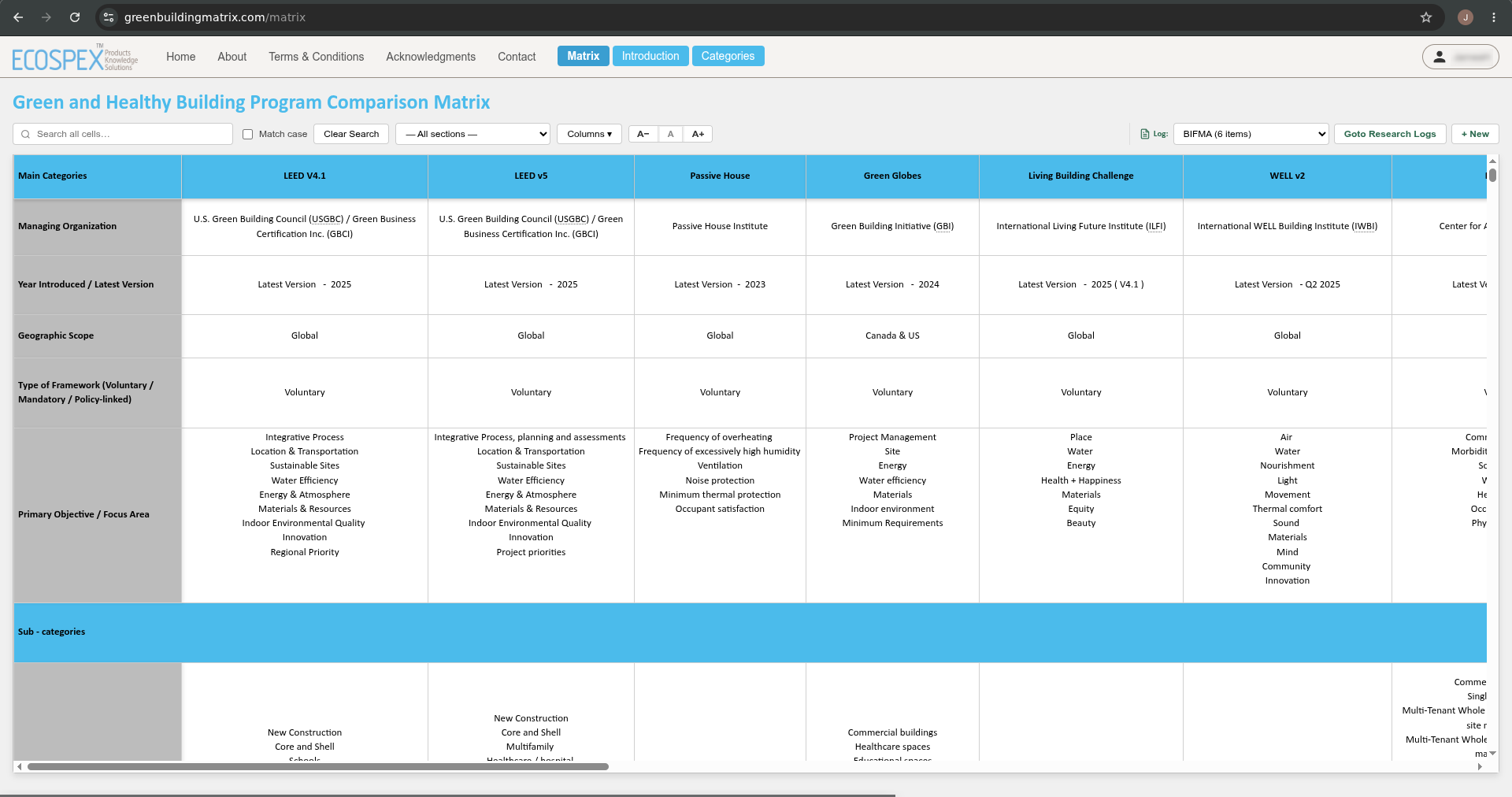
- 11 certification systems — including LEED, WELL, Passive House Institute, Green Globes, RESET, Toronto Green Standard, Zero Carbon Building Standards, and Living Futures Institute — across 17 categories and 578 comparison rows
- The researcher's workflow, untouched. The matrix publishes from the spreadsheet the lead researcher already maintains — no CMS training, no data re-entry, no developer involvement per update
- Seat-based team subscriptions with tiered volume pricing — organizations buy seats, invite their own teams, and manage access themselves
- ~30 minutes from never-having-touched-Drupal to an editor's first published page
Stage 1 — Expertise, Constrained
EcoSpex is an industry advisory and research practice serving sustainability professionals. Its core offering is expertise in green building certification: how different rating programs approach sustainable design and construction, where they align, where they diverge, and which one fits a given project.
The product's promise today states the value plainly: streamline credit mapping, improve accountability, meet compliance faster.
That expertise was precise, peer-reviewed, and genuinely valuable. It was also accessible only through direct engagement with the researcher, and it lived in a spreadsheet. Architects and engineers routinely spent hours across separate reference guides answering a question the researcher had already solved — with no way to reach the solution.
The constraint was never the knowledge. It was the delivery mechanism.
Stage 2 — Expertise, Accessible
The Core Design Decision: The Spreadsheet Stays the Source of Truth
Most projects like this begin by migrating the expert's data into a new system — and quietly break the process that kept the data accurate in the first place. We inverted that.
The platform publishes from the researcher's existing workbook. Its structure carries meaning, so the generator preserves full structural fidelity: sticky headers, frozen columns, merged cells, section dividers. When the researcher updates the spreadsheet, the published matrix updates with it. Their workflow did not change; their work simply became a product.
Two Surfaces, One CMS
The central architectural insight is that the platform has two entirely different content surfaces with two different authoring models — both served from a single Drupal 11 installation.
The editor-owned marketing site. All public-facing pages are authored in Drupal Gutenberg using a bespoke 17-block design library, each ported one-to-one from a static mockup with a specification document and editor-parity CSS. A non-technical editor composes and publishes a landing page in roughly 30 minutes.
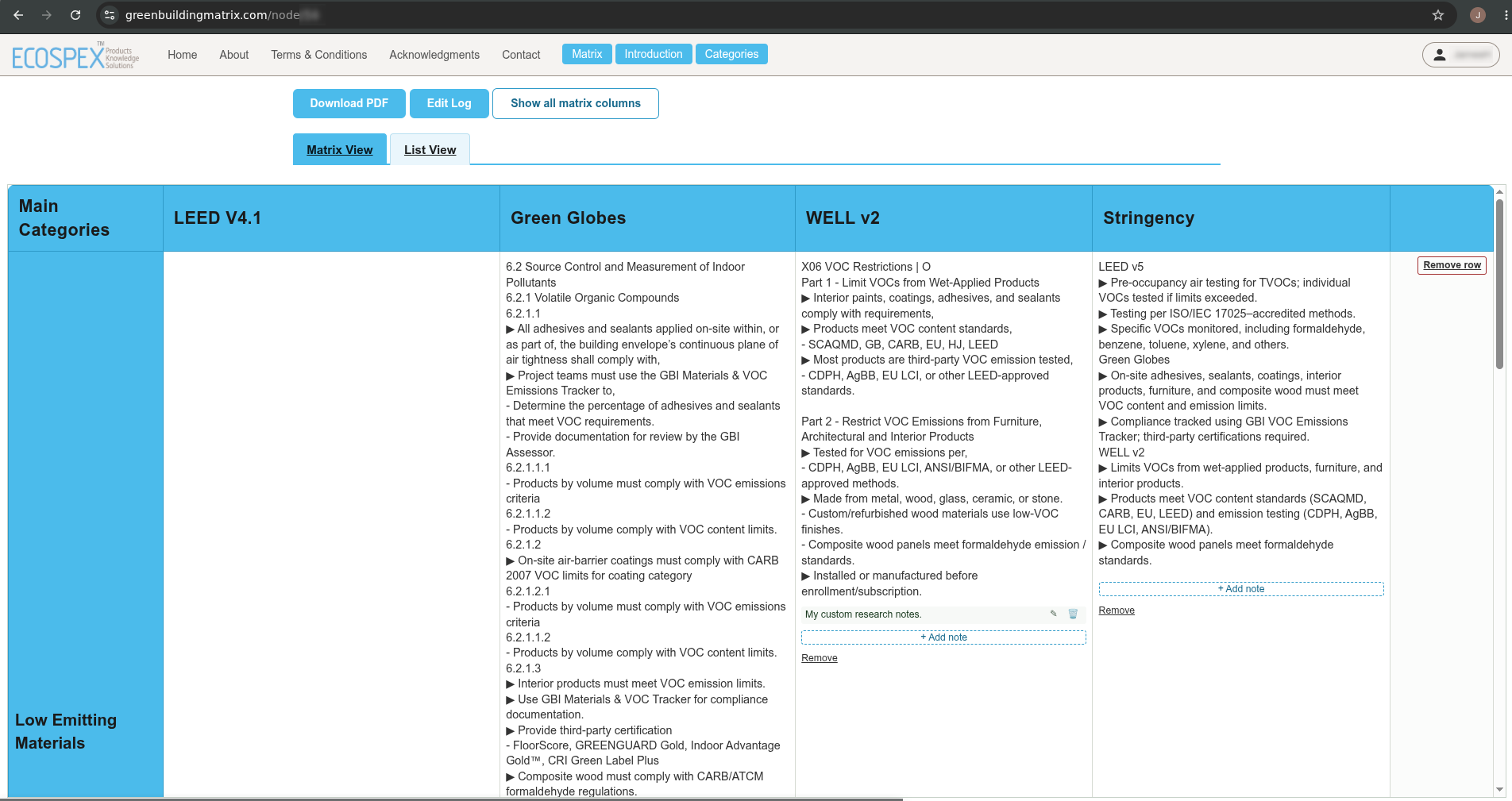
The matrix viewer. A self-contained interactive artifact generated deterministically from the researcher's source data. At request time a custom Drupal controller injects site navigation, research-log functionality, and cache-busting before serving it. The platform adds context; the researcher's methodology remains the source of truth.
The Research Log
The research log turns reading into working. Subscribers click any credit in the matrix to collect it, organize collections into named and annotated logs, and export polished PDFs for client proposals and design reviews. It is the difference between a reference subscribers consult and a tool they build their deliverables in.
The matrix and research log are deliberately decoupled, bridged by a lightweight JavaScript layer — 81 JSDOM tests across 7 files validate every helper, with zero failures across the build cycle.
Subscription and Seat Model
Access is gated behind a seat-based subscription via Drupal Commerce and Organic Groups. Organizations purchase seat bundles with volume pricing, owners invite their own team members, and access follows the seat. The price resolver runs server-side on every checkout step and carries 100% branch coverage in unit tests — the highest-blast-radius code in the project.

Notable Technical Challenges
| Challenge | Root Cause | Resolution |
|---|---|---|
| PDF uploads silently failing in Gutenberg | Contrib MediaUploader emits PHP warnings into the JSON response for file fields | 4-line composer-patches patch, applied at production install |
| Editor canvas layout regressions | Gutenberg interposes wrapper divs that break CSS grid relationships | Editor-only CSS using display: contents to flatten wrappers; transparent on the front end |
| Hosting docroot locked | Active hosting plan prevents document root changes | Per-file symlink fan-out; vendor and config kept outside the web-served tree |
| Matrix asset cache invalidation across deploys | Browser serves stale assets against new inline scripts | Shared mtime-based version parameter, bumped atomically on any relevant deploy |
Security and Dependency Currency
- Drupal core highly-critical SQL injection advisory patched end-to-end within 24 hours
- Six Symfony CVEs patched in the same sprint
- Contrib bug patched via
composer-patchesrather than waiting on upstream
Metrics and Results
| Category | Metric |
|---|---|
| Build velocity | 296 commits over 10 weeks, single developer |
| Code volume | ~33,700 lines across 252 files |
| Block library | 17 editor-facing blocks; 31 specification documents |
| Test discipline | 81 JSDOM tests; zero failures across the build cycle |
| Security | Highly-critical advisory patched within 24 hours |
| Onboarding | ~30 minutes to first published page |
| Performance | ~2s TTI landing pages; ~1.8s matrix viewer |
Replicable Principles
- The expert's methodology is the engine. It drives the platform and remains the source of truth.
- Two surfaces, one CMS. Marketing pages and the core product have different authoring models — separate them architecturally, unify them under one infrastructure.
- Test the highest-blast-radius logic first. The price resolver has 100% branch coverage.
- Patch, don't wait. Fast security response is a competitive advantage.
- The first product validates the market. It earns revenue and proves demand before any larger investment is committed.
Partnership
Developed in partnership with EcoSpex, a sustainability verification and research practice serving green building professionals across North America. Explore the platform at greenbuildingmatrix.com.
James Hickman of Rational Boxes is Fractional CTO and lead software architect at EcoSpex Inc.
This is an ongoing engagement. Rational Boxes continues as EcoSpex's technical partner, with next-generation automation in active development.
Rational Boxes — Deep expertise, multiplied.
Tell us about your expertise to discuss multiplying the reach of your own methodology.